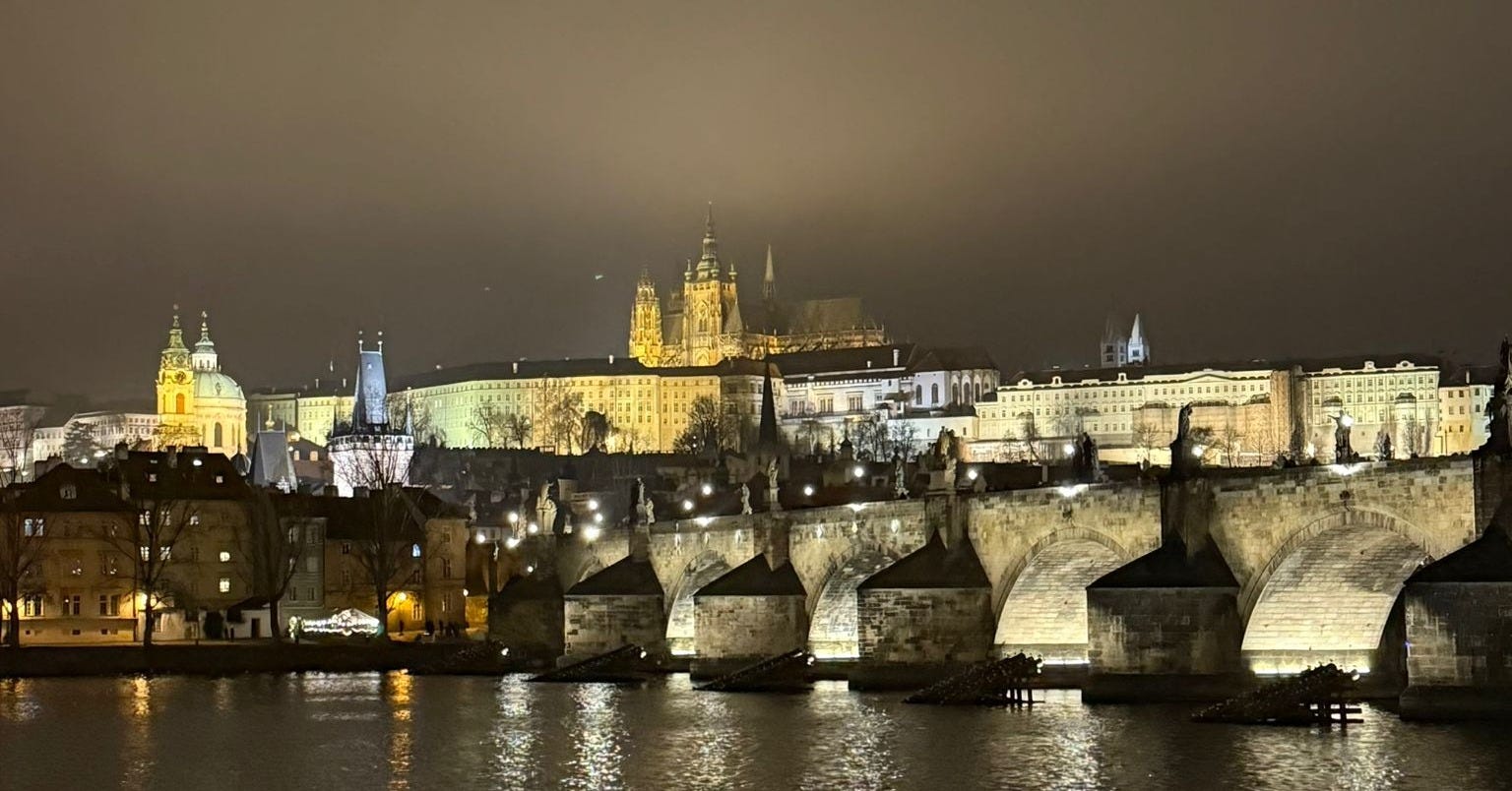
Learning to live here
Notes from Prague on place, lineage, and attention

Prague is my first stop as a digital nomad. I arrived with a suitcase, a work routine, and the familiar urge to be efficient about a new place.
For the first few days I did ‘modern travel’… maximising exposure, minimising down time and rushed around from site to site, getting the good pics, getting my bearings… as though I only had a few days in town.
Then I slowed down. I stopped moving through Prague as a place to see and started living inside it. Sitting longer, lingering and absorbing. When I wander through Prague’s laneways, cathedrals and palaces there’s a lot to listen to.
It is layered with Gothic, Renaissance, Romanesque and Baroque buildings all on top of each other. Turn down a laneway expecting one era and get another. Step a few blocks from the centre, the city shifts again, less ornate, more functional and still carrying the marks of communism.
What I’m leaving behind
Moving has meant letting go of obvious things like places, my stuff, routines, and proximity to people I love.
But the more useful question for me as I started on my flight: what doesn’t need to come with me? Limitation came to mind. Limitation that creates contraction, isolation, restriction, fragmentation. Phoof!! Letting all that go!
What I’ve learned about me this year is that I don’t need to do fragmentation or separation. It is all me. This move isn’t about reinvention or activation. It’s about alignment.
Travel always makes this more obvious. Without familiar structures around me, what works stays. What doesn’t has to fall away fast.
I’ve learned I value clarity over volume, depth over scale, and environments that allow for sustained attention rather than constant stimulation. I work best when my nervous system is calm and my days have space in them. Space to hear the messages.
Messages that come through
I’m drawn to places with tangible lineage. The work I do depends on recognising inherited patterns - in people, organisations, and systems. Being in environments with generational layers sharpens my gifts. Cities where you can see how one generation has built on top of another, sometimes carefully and more often than not, completely erasing what physically came before.
For instance, cathedrals and temples were designed to organise human behaviour: where you look, how you move, what you feel small inside of. In some, the emphasis is containment. In others, expansion. In a few, it’s reassurance.
Palaces carry something different. Strategy. Control. Legacy. These were operational environments, and the messages reflect that: how authority was held and where it collapsed under its own weight.
Prague’s lineage is so deep and incredibly intertwined - from pagan solar rites, Slavic goddesses, to Judaism, Christian sovereignty, renaissance alchemy and astronomical intelligence. Its buildings hold deep observations and generational insights about power, faith, grief, leadership and endurance.
The messages aren’t about the past for its own sake. I’ll be recording some YouTube videos on their relevance today for how we humans organise power, meaning, and belonging.